US EV Charging Infrastructure: 3 Key Updates on Public Charger Deployment
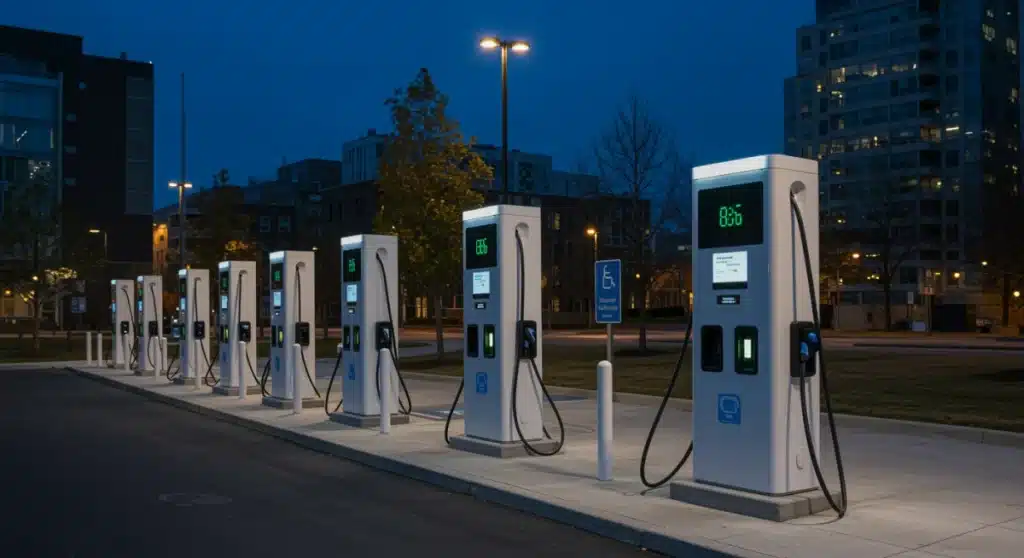
Three significant updates in public charger deployment across the United States over the last three months underscore a concerted national effort to accelerate the expansion of electric vehicle charging infrastructure.
The landscape of electric vehicle (EV) adoption in the United States is rapidly evolving, driven by technological advancements and supportive policies. Understanding the recent shifts in public charging availability is crucial for both current and prospective EV owners. In this article, we will delve into the significant progress made in Charging Infrastructure Growth in the US: 3 Key Updates on Public Charger Deployment in the Last 3 Months, offering a clear picture of the ongoing transformation.
The National Electric Vehicle Infrastructure (NEVI) Program’s Accelerating Impact
The National Electric Vehicle Infrastructure (NEVI) Formula Program, a cornerstone of the Bipartisan Infrastructure Law, continues to be a primary catalyst for the expansion of public EV charging in the United States. Over the last three months, several states have moved from planning stages to active deployment, marking a crucial transition from policy to tangible infrastructure.
This period has seen a significant acceleration in project approvals and groundbreaking ceremonies for new charging stations, particularly along designated alternative fuel corridors. The NEVI program aims to establish a reliable, convenient, and equitable charging network across the nation, ensuring that drivers have access to fast chargers every 50 miles along major highways.
State-Level NEVI Rollouts and Milestones
Individual states are now actively implementing their NEVI plans, translating federal funds into operational charging sites. This involves a complex process of site selection, procurement, and construction, often in partnership with private sector charging providers. Many states are prioritizing high-traffic routes and underserved areas to maximize the program’s impact.
- Increased Project Approvals: Numerous state transportation departments have announced a surge in approved NEVI-funded charging projects, moving from initial proposals to contracts.
- Groundbreaking Ceremonies: Several states have celebrated the commencement of construction for their first NEVI-compliant charging stations, signaling tangible progress on the ground.
- Private Sector Partnerships: Charging network operators are actively collaborating with states, leveraging NEVI funds to expand their footprints and ensure interoperability.
The NEVI program’s focus on high-power DC fast chargers (at least 150 kW per port) and stringent uptime requirements (97% reliability) is setting a new standard for public charging infrastructure. These developments are directly addressing long-standing concerns about charging availability and reliability, which are critical for increasing consumer confidence in electric vehicles. The recent three months have shown a clear commitment to accelerating these deployments, with a noticeable increase in visible construction and operational sites across various states.
Expansion of Major Charging Networks: New Partnerships and Locations
Beyond government initiatives, private charging network operators are aggressively expanding their footprints, often through strategic partnerships and innovative deployment models. The last three months have witnessed significant announcements from major players in the EV charging space, indicating a robust and competitive market driving infrastructure growth.
These expansions are not just about adding more chargers; they involve strategic placement in high-demand areas, integration with existing amenities, and the introduction of advanced charging technologies. The goal is to make charging as seamless and convenient as possible for EV drivers, mirroring the ease of fueling a gasoline-powered car.
Strategic Alliances and Investment Influx
Recent months have seen a flurry of activity regarding new partnerships between charging companies, automakers, and retail giants. These collaborations often aim to co-locate charging stations with popular shopping centers, rest stops, and other destinations, making charging a part of daily routines rather than a separate chore. Investment in these networks continues to pour in, reflecting strong confidence in the future of electric mobility.
- Automaker Collaborations: Several automakers have announced partnerships with charging networks to provide preferential access or integrated billing for their customers.
- Retailer Integrations: Major retail chains are increasingly hosting charging stations, offering customers the convenience of charging while they shop.
- New Funding Rounds: Charging companies have secured substantial investments, enabling them to expand their infrastructure at an unprecedented pace.
This concerted effort from private entities complements federal initiatives, creating a multi-faceted approach to building out the national charging ecosystem. The focus on high-speed charging and user experience is paramount, with many new installations featuring multiple charging stalls and amenities for drivers while they wait. This surge in private sector activity is a clear indicator of the rapid Charging Infrastructure Growth in the US: 3 Key Updates on Public Charger Deployment in the Last 3 Months, demonstrating a collective push towards a fully electrified transportation system.
Technological Advancements and Improved User Experience
The evolution of EV charging infrastructure isn’t solely about the quantity of chargers; it’s also about the quality and user experience. The past three months have brought forth notable advancements in charging technology and significant improvements aimed at making the charging process more reliable, faster, and more user-friendly. These innovations are critical for overcoming common barriers to EV adoption.
From faster charging speeds to more intuitive payment systems, the industry is responding to driver feedback and striving to create a seamless charging experience. These technological leaps are fundamental to ensuring that the growing number of EVs on American roads can be supported efficiently and effectively.
Innovations in Charging Speed and Reliability
The continuous push for faster charging is evident, with more 350 kW and even higher-power chargers entering deployment. This allows for significantly reduced charging times, making long-distance travel in an EV more practical. Concurrently, efforts to enhance charger reliability and uptime are gaining traction, with network operators implementing advanced diagnostics and proactive maintenance.
- Ultra-Fast DC Charging: Deployment of chargers capable of delivering 350 kW or more is becoming more common, drastically cutting down charging durations.
- Enhanced Software and Diagnostics: Charging networks are leveraging sophisticated software to monitor charger health, predict potential issues, and improve overall uptime.
- Plug-and-Charge Technology: The gradual rollout of Plug-and-Charge, allowing for automatic payment upon plugging in, is simplifying the charging process for compatible vehicles.
These technological improvements are directly addressing key pain points for EV drivers, such as range anxiety and the perceived complexity of public charging. By making charging faster and more dependable, the industry is building greater confidence in electric vehicles as a viable and convenient mode of transportation for all. The focus on user experience, encompassing everything from payment options to the physical design of charging stations, represents a crucial part of the Charging Infrastructure Growth in the US: 3 Key Updates on Public Charger Deployment in the Last 3 Months, ensuring that infrastructure keeps pace with vehicle demand.
Regional Initiatives and Local Impact
While federal programs and national networks lay the groundwork, regional and local initiatives play a vital role in tailoring charging solutions to specific community needs. Over the past three months, many cities and counties across the US have launched or expanded their own EV infrastructure programs, demonstrating a localized commitment to sustainable transportation.
These efforts often target areas not immediately covered by federal highway programs, such as urban centers, multi-unit dwellings, and workplaces. The localized approach allows for greater flexibility and responsiveness to the unique demands of different communities, fostering equitable access to charging.
Community-Driven Charging Projects
Local governments and community organizations are increasingly taking the lead in deploying charging infrastructure, often through grants, public-private partnerships, and innovative zoning policies. These projects focus on providing convenient charging options where people live, work, and recreate.
- Urban Charging Hubs: Many cities are establishing dedicated EV charging hubs in downtown areas and commercial districts, often integrating them with public parking facilities.
- Workplace Charging Incentives: Local programs are encouraging businesses to install workplace chargers through rebates and technical assistance.
- Multi-Unit Dwelling Solutions: Efforts are underway to address the challenge of charging for residents of apartments and condominiums, including pilot programs for shared charging.
These localized initiatives are crucial for filling gaps in the broader charging network and ensuring that EV adoption is accessible to a wider demographic. They often involve extensive community engagement to identify optimal locations and address local concerns. The collective impact of these regional and local projects significantly contributes to the overall Charging Infrastructure Growth in the US: 3 Key Updates on Public Charger Deployment in the Last 3 Months, fostering a more comprehensive and equitable charging ecosystem across the nation.
Addressing Grid Challenges and Sustainability
The rapid expansion of EV charging infrastructure naturally raises questions about the capacity and resilience of the electrical grid. Over the past three months, there has been an increased focus on integrating renewable energy sources and smart grid technologies into charging solutions to ensure sustainability and minimize strain on existing power systems.
This includes exploring innovations like battery storage at charging sites, vehicle-to-grid (V2G) technology, and intelligent load management systems. The goal is to not only power EVs but to do so in an environmentally responsible and grid-friendly manner, preparing for a future with millions of electric vehicles.
Smart Grid Integration and Renewable Energy
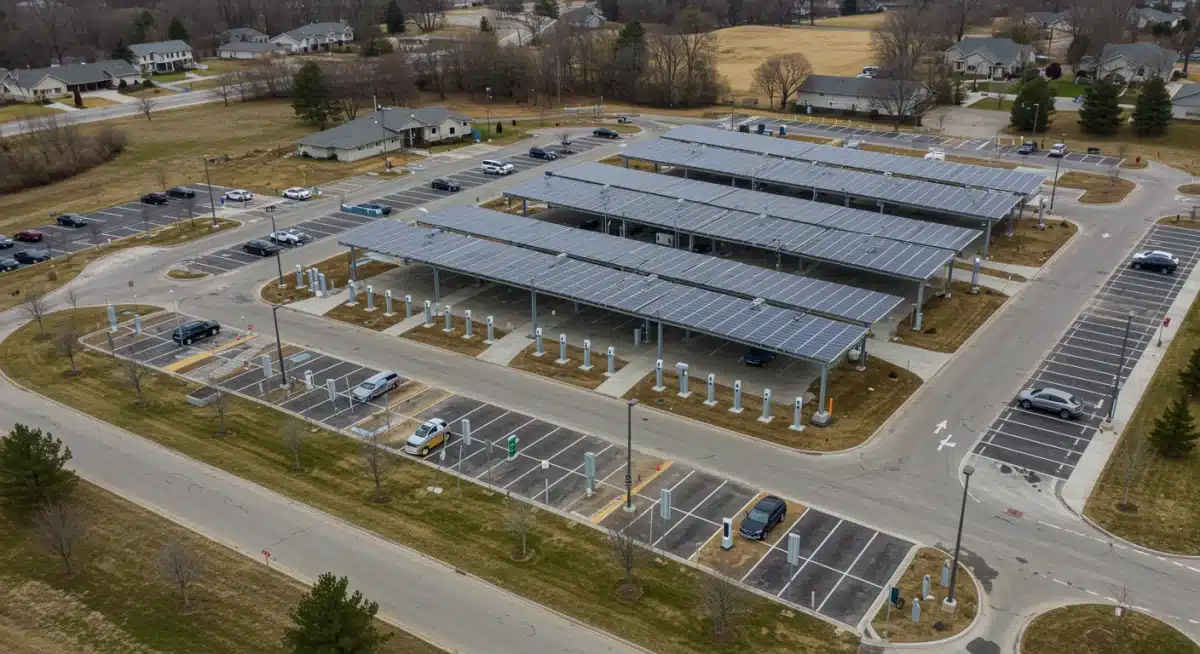
Utilities and charging providers are collaborating more closely to develop solutions that optimize energy consumption and integrate renewable energy. This includes demand response programs and the deployment of solar canopies over charging stations, making the charging process greener and more efficient.
- Battery Storage Solutions: Implementation of battery storage at high-power charging sites helps manage peak demand and reduce grid impact.
- Solar-Powered Charging: An increasing number of new charging installations are incorporating solar panels, either on canopies or integrated into the station design, for sustainable power.
- V2G Pilot Programs: Research and pilot projects for vehicle-to-grid (V2G) technology are exploring how EVs can support grid stability by feeding power back during peak demand.
These efforts underscore a holistic approach to EV infrastructure development, recognizing that simply adding chargers is not enough. The sustainability and efficiency of the power source are equally important for the long-term viability of electric transportation. The progress in integrating these smart and green solutions is a vital aspect of the Charging Infrastructure Growth in the US: 3 Key Updates on Public Charger Deployment in the Last 3 Months, paving the way for a more resilient and sustainable energy future.
The Road Ahead: Future Projections and Continued Momentum
The momentum observed in the last three months sets a strong precedent for continued growth in US EV charging infrastructure. Looking forward, the trajectory suggests an even more accelerated pace of deployment, driven by ongoing federal investments, private sector innovation, and increasing consumer demand.
Future projections indicate a significant increase in both the number and density of charging stations, alongside further advancements in charging technology and user experience. The goal remains to achieve a robust and seamless charging ecosystem that can comfortably support the anticipated surge in EV adoption.
Anticipated Developments and Industry Outlook
The coming months are expected to bring more operational NEVI sites, further expansions from major charging networks, and continued technological refinements. The industry is also focusing on standardization and interoperability to ensure a consistent experience across different charging providers and vehicle models.
- NEVI Program Maturation: More states will transition from planning to full-scale construction and operation of NEVI-compliant charging stations.
- Increased Charging Port Density: A greater number of charging ports, particularly fast chargers, will become available in both urban and rural areas.
- Enhanced Interoperability: Industry efforts will continue to improve communication and payment systems between different charging networks and vehicle brands.
The commitment from government, industry, and local communities to build out a world-class EV charging network is unwavering. The updates from the last three months serve as a strong indicator of this progress, highlighting a period of significant achievement and setting the stage for an even more electrified future. This sustained effort is crucial for the continuous Charging Infrastructure Growth in the US: 3 Key Updates on Public Charger Deployment in the Last 3 Months, ensuring the United States remains at the forefront of the electric vehicle revolution.
| Key Update | Brief Description |
|---|---|
| NEVI Program Acceleration | Increased state-level project approvals and groundbreakings for compliant fast chargers along major corridors. |
| Private Network Expansion | Major charging companies announced new partnerships and significant investments, expanding their station footprints. |
| Technological Advancements | Deployment of ultra-fast chargers and improved user experience features like Plug-and-Charge gained traction. |
| Regional Initiatives | Local governments and communities launched targeted programs for urban, workplace, and multi-unit dwelling charging. |
Frequently Asked Questions About US EV Charging Growth
The National Electric Vehicle Infrastructure (NEVI) Formula Program is a federal initiative funding the deployment of high-power DC fast chargers along designated highway corridors. It’s significantly accelerating the build-out of a reliable national charging network by providing states with funds and setting standards for charger performance and uptime.
Yes, there’s a concerted effort to improve reliability. NEVI program mandates a 97% uptime, and private networks are investing in advanced diagnostics and proactive maintenance. New technologies and increased competition are pushing operators to ensure a more dependable charging experience for drivers across the US.
Private companies are crucial, expanding their networks through substantial investments and strategic partnerships with automakers and retailers. They drive innovation in charging technology, enhance user experience, and complement federal efforts by deploying chargers in diverse locations, including urban centers and commercial areas.
Technological advancements are leading to ultra-fast DC chargers, significantly reducing charging times. Improvements in software and diagnostics enhance reliability. Additionally, features like Plug-and-Charge simplify payment and authentication, making the overall charging process more seamless and user-friendly for EV owners.
The industry is actively addressing this by integrating smart grid technologies, renewable energy sources, and battery storage solutions at charging sites. Efforts also include vehicle-to-grid (V2G) pilot programs and intelligent load management to optimize energy consumption and minimize strain on the existing electrical infrastructure.
Conclusion
The last three months have undeniably marked a period of robust acceleration in the development of public EV charging infrastructure across the United States. From the tangible progress of the NEVI program and the strategic expansions of private networks to the continuous advancements in charging technology and localized initiatives, the momentum is clear. These collective efforts are systematically dismantling barriers to EV adoption, fostering an environment where electric vehicles are not just an aspiration but a practical and convenient reality for more Americans. The commitment to building a reliable, accessible, and sustainable charging ecosystem underscores a pivotal shift towards a fully electrified transportation future, promising significant benefits for both consumers and the environment.