2026 EV Tax Credits: What US Buyers Must Know Before January 1
The 2026 EV Tax Credits: What US Buyers Need to Know Before January 1
The electric vehicle (EV) revolution is accelerating, and with it, the incentives designed to encourage adoption. For US buyers, understanding the evolving landscape of tax credits is paramount, especially as we approach January 1, 2026. The coming year marks significant shifts in the criteria and availability of the Clean Vehicle Tax Credit, commonly known as the EV tax credit. This comprehensive guide will delve deep into what US buyers need to know about the 2026 EV tax credits, helping you navigate the complexities and make informed decisions before the new year ushers in potential changes.
The push for electric vehicles is not just about environmental sustainability; it’s also about energy independence and fostering domestic manufacturing. Government incentives, particularly the 2026 EV tax credits, play a crucial role in making these advanced vehicles more accessible to the average consumer. However, these credits are not static. They are subject to legislative adjustments, evolving supply chain requirements, and market dynamics. Missing out on critical information could mean missing out on thousands of dollars in savings. Therefore, being prepared and understanding the nuances of the upcoming changes is not merely beneficial; it’s essential.
This article aims to be your definitive resource, covering everything from eligibility criteria and vehicle requirements to the impact of battery component sourcing and income limitations. We will break down the complexities of the 2026 EV tax credits, providing clarity on how these changes might affect your next EV purchase. Whether you’re a first-time EV buyer or looking to upgrade, the information presented here will empower you to maximize your potential savings and contribute to a greener future.
Understanding the Current EV Tax Credit Landscape
Before we dive into the specifics of the 2026 EV tax credits, it’s vital to understand the foundation upon which these future changes will be built. The current Clean Vehicle Tax Credit, largely shaped by the Inflation Reduction Act (IRA) of 2022, offers up to $7,500 for eligible new clean vehicles and up to $4,000 for eligible used clean vehicles. This incentive is designed to reduce the upfront cost of EVs, making them more competitive with traditional gasoline-powered cars.
Key Components of the Current Credit:
- New Clean Vehicle Credit ($7,500): This credit is split into two main components, each worth $3,750, based on specific manufacturing and sourcing requirements.
- Used Clean Vehicle Credit ($4,000): A credit for pre-owned EVs, subject to vehicle age, price, and seller requirements.
Eligibility for New Vehicles:
To qualify for the full $7,500 credit, new EVs must meet several stringent criteria:
- Battery Capacity: The vehicle must have a battery capacity of at least 7 kilowatt hours (kWh).
- Gross Vehicle Weight Rating (GVWR): The EV’s GVWR must be less than 14,000 pounds.
- Manufacturer’s Suggested Retail Price (MSRP) Limits: This is a critical factor. For vans, SUVs, and pickup trucks, the MSRP cannot exceed $80,000. For other vehicles (sedans, coupes, etc.), the MSRP limit is $55,000.
- Final Assembly in North America: A significant requirement introduced by the IRA, ensuring that a substantial portion of the vehicle’s manufacturing occurs within North America. This list of eligible vehicles changes frequently, so checking the DOE’s website is crucial.
- Battery Component Sourcing: This is where much of the complexity lies and where the 2026 EV tax credits will see the most significant changes.
Battery Component Sourcing Breakdown:
The $7,500 credit is divided into two $3,750 portions, each with its own sourcing requirements:
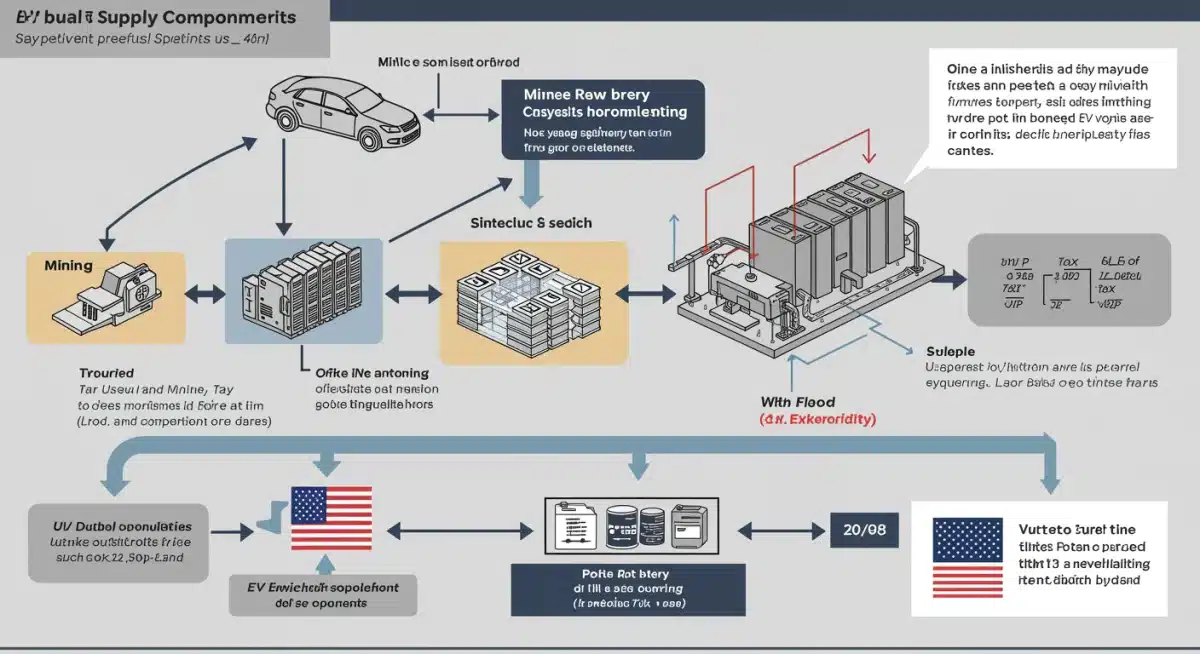
- Critical Minerals Requirement ($3,750): A certain percentage of the critical minerals used in the battery must be extracted or processed in the United States or a country with which the US has a free trade agreement, OR be recycled in North America. This percentage increases annually.
- Battery Components Requirement ($3,750): A certain percentage of the battery components must be manufactured or assembled in North America. This percentage also increases annually.
These escalating percentages are key to understanding the impending changes for the 2026 EV tax credits. As the requirements become stricter, fewer vehicles may qualify for the full credit unless manufacturers adapt their supply chains.
Income Limitations:
The current tax credits are also subject to income limitations, designed to target the incentives towards a broader range of consumers:
- New Clean Vehicles: Modified Adjusted Gross Income (MAGI) cannot exceed $300,000 for married couples filing jointly, $225,000 for heads of households, or $150,000 for all other filers.
- Used Clean Vehicles: MAGI cannot exceed $150,000 for married couples filing jointly, $112,500 for heads of households, or $75,000 for all other filers.
It’s important to note that these income thresholds apply to the year the vehicle is delivered or the preceding year, whichever is less. This means buyers need to consider their income from both years when planning a purchase.
The January 1, 2026 Deadline: What Changes Are Coming?
The most significant and anticipated changes regarding the 2026 EV tax credits revolve around the battery component sourcing requirements. The Inflation Reduction Act included a specific provision that will dramatically impact eligibility starting January 1, 2026. This provision targets the exclusion of battery components from "foreign entities of concern."
Exclusion of Foreign Entities of Concern (FEOC):
- Beginning in 2024, vehicles with battery components manufactured or assembled by a FEOC are ineligible for the clean vehicle credit. However, a more stringent rule comes into effect for 2026:
- January 1, 2026: Vehicles with any applicable critical minerals extracted, processed, or recycled by a FEOC will be ineligible for the credit. This is a crucial distinction. While the 2024 rule focused on battery components, the 2026 rule extends this ban to the critical minerals themselves.
This change is designed to further reduce reliance on non-allied nations, particularly China, in the EV supply chain. The implication is profound: if even a tiny fraction of the critical minerals in an EV battery originates from a FEOC, the entire vehicle could lose its eligibility for the federal tax credit. This will force automakers to meticulously audit their entire supply chain, from the mine to the assembly line, to ensure compliance.
Increasing Domestic Content Requirements:
In addition to the FEOC restrictions, the percentages for domestic content for both critical minerals and battery components continue to increase annually up to 2027 and 2029, respectively. While the most dramatic shift is the FEOC ban, the escalating percentages mean that even compliant manufacturers will need to continually deepen their North American sourcing and processing efforts to maintain full credit eligibility.
- Critical Minerals: The percentage of critical minerals sourced or processed in the US/FTA countries, or recycled in North America, needed to qualify for the $3,750 credit increases year by year.
- Battery Components: Similarly, the percentage of battery components manufactured or assembled in North America needed for the other $3,750 credit also rises annually.
These increasing thresholds, coupled with the FEOC ban, create a highly dynamic environment for both manufacturers and consumers. What qualifies today may not qualify next year, making timely purchases and diligent research critical for those hoping to leverage the 2026 EV tax credits.
Impact on EV Manufacturers and Vehicle Availability
The impending changes for the 2026 EV tax credits, particularly the FEOC rules, place immense pressure on EV manufacturers. Companies that have relied heavily on supply chains linked to foreign entities of concern are scrambling to reconfigure their sourcing strategies. This is not a simple task, as establishing new critical mineral extraction, processing, and battery component manufacturing facilities is capital-intensive and time-consuming.
Supply Chain Restructuring:
Automakers are investing billions in North American and allied-nation supply chains. This includes:
- Developing new mines: Sourcing lithium, cobalt, nickel, and graphite from countries with free trade agreements with the US.
- Building processing facilities: Establishing plants in North America to process raw critical minerals into battery-grade materials.
- Expanding battery manufacturing: Constructing gigafactories for battery cell and pack assembly within the US and its free trade partners.
These efforts are long-term, and some manufacturers may struggle to meet the 2026 deadline for full compliance across their entire EV lineup. This could lead to a temporary reduction in the number of EVs eligible for the full $7,500 credit, or even any credit at all, come January 1, 2026.
Reduced Eligible Models:
It is plausible that the pool of eligible vehicles for the full 2026 EV tax credits will shrink, at least initially. While manufacturers are working diligently, the complexity and global nature of the EV supply chain mean that achieving 100% compliance with the FEOC rules for critical minerals will be a monumental challenge. Consumers should be prepared for a period where fewer models might qualify, or some models might only qualify for a partial credit.
Price Adjustments:
The increased cost of reconfiguring supply chains and potentially sourcing materials from more expensive, compliant regions could impact vehicle pricing. While the tax credit aims to lower the effective cost for consumers, the underlying MSRP of some EVs might see adjustments as manufacturers pass on some of these new operational expenses. This makes the timing of your purchase, especially before January 1, 2026, even more critical if you are aiming for maximum savings.
Strategic Planning for US Buyers: Maximizing Your Savings Before 2026
Given the significant changes slated for the 2026 EV tax credits, proactive planning is essential for US buyers looking to capitalize on current incentives. Waiting until after January 1, 2026, could mean fewer eligible vehicles or reduced credit amounts. Here’s how you can strategically plan your EV purchase:
1. Research Current Eligibility:
The first step is to identify which vehicles currently qualify for the full $7,500 credit. The Department of Energy (DOE) website is the official source for this information, updated regularly. Pay close attention to both the final assembly and battery component/critical mineral sourcing requirements. This list is your baseline for what is currently available and incentivized.
2. Understand Your Income Limitations:
Before getting your heart set on a particular model, verify that your Modified Adjusted Gross Income (MAGI) falls within the specified limits for the year of delivery or the preceding year. Consult with a tax professional if you have complex income situations to ensure you meet the criteria for the 2026 EV tax credits or the current ones.
3. Consider Leasing vs. Buying:
For some buyers, leasing an EV might be a more straightforward way to benefit from federal incentives, especially if their income exceeds the MAGI limits for purchasing. The commercial clean vehicle tax credit, which is different from the consumer credit, allows dealerships to claim the credit and often pass it on to lease customers as a reduction in the lease price, regardless of the customer’s income or the vehicle’s specific domestic content. This could be a viable workaround for vehicles that might lose their consumer credit eligibility but still qualify under commercial rules.
4. Act Sooner Rather Than Later:
If you have a specific EV in mind that currently qualifies for the full credit, and you meet the income requirements, purchasing and taking delivery before January 1, 2026, is likely your best strategy. This ensures you benefit from the current, potentially more lenient, eligibility rules before the FEOC restrictions on critical minerals take full effect. Dealerships often have waiting lists for popular EV models, so starting your search well in advance is advisable.
5. Stay Informed on Manufacturer Announcements:
Automakers are actively working to reconfigure their supply chains. Keep an eye on announcements from your preferred EV manufacturers regarding their compliance with future tax credit rules. Some manufacturers may be more transparent than others about their progress in meeting the 2026 EV tax credits requirements. Subscribing to industry news and manufacturer newsletters can keep you updated.
6. Explore State and Local Incentives:
Federal tax credits are just one piece of the puzzle. Many states and local municipalities offer their own incentives for EV purchases, including rebates, tax credits, and even HOV lane access. These incentives often have different eligibility criteria and can significantly reduce the overall cost of an EV. Researching these localized programs can complement any federal savings you might secure.
The Future of EV Incentives Beyond 2026
While the focus is currently on the immediate changes impacting the 2026 EV tax credits, it’s also worth considering the long-term trajectory of EV incentives. The government’s goal is to accelerate EV adoption, reduce emissions, and boost domestic manufacturing. As the market matures and EV prices become more competitive with internal combustion engine (ICE) vehicles, it’s possible that federal incentives may gradually phase out or shift in focus.
Potential Policy Evolutions:
- Further Refinement of Sourcing Rules: The FEOC rules are a significant step, but future legislation could introduce even more granular requirements or expand the definition of "foreign entities of concern."
- Focus on Specific Vehicle Segments: Incentives might be adjusted to prioritize certain types of EVs, such as electric trucks or commercial vehicles, which are critical for decarbonizing freight and utility sectors.
- Charging Infrastructure Credits: While significant investments are already being made, future policies might place a greater emphasis on credits for home charging installations or public charging network expansion, recognizing that infrastructure is key to widespread adoption.
- Means-Testing Adjustments: The income caps for the Clean Vehicle Credit could be adjusted in future years, either becoming stricter or more lenient depending on economic conditions and policy goals.
The overarching trend suggests a continued push towards robust domestic supply chains and manufacturing. This not only strengthens the US economy but also enhances national security by reducing reliance on potentially unstable foreign sources for critical EV components. For consumers, this means that while the specific rules for the 2026 EV tax credits are immediate concerns, the broader direction points to an increasingly localized and resilient EV ecosystem.
Common Questions About the 2026 EV Tax Credits
Q1: Will all EVs lose their tax credit on January 1, 2026?
A: No, not all EVs will lose their tax credit. The primary change is that vehicles containing any critical minerals in their batteries extracted, processed, or recycled by a "foreign entity of concern" will become ineligible. Vehicles that meet the North American final assembly, battery component, and critical mineral sourcing requirements (without FEOC involvement) will continue to qualify, provided they also meet MSRP and income thresholds.
Q2: How can I check if a specific EV will qualify for the 2026 EV tax credits?
A: The official resource is the Department of Energy (DOE) website. However, it’s important to note that the DOE list for 2026 eligibility based on the critical minerals FEOC rule might not be fully updated until closer to the date, as manufacturers confirm their supply chains. For now, focus on current eligibility and be prepared for potential changes. Consulting with the dealership and a tax professional is also recommended.
Q3: What if I order an EV in 2025 but it’s delivered in 2026?
A: The eligibility for the Clean Vehicle Credit is determined by the rules in effect on the date the vehicle is delivered to the taxpayer. So, if your vehicle is delivered on or after January 1, 2026, it will be subject to the new FEOC critical mineral rules and any other updated requirements for the 2026 EV tax credits. This highlights the importance of understanding lead times and delivery schedules.
Q4: Do used EVs also have new rules for 2026?
A: The primary FEOC restrictions specifically target new clean vehicles. The Used Clean Vehicle Credit has its own set of criteria, including a maximum sale price of $25,000, being at least two model years old, and being purchased from a dealer. While these rules might also be subject to future legislative review, the immediate and most impactful changes for 2026 relate to new vehicle critical mineral sourcing.
Q5: Is it better to buy or lease an EV to get the tax credits?
A: It depends on your individual circumstances. If you meet the income requirements and the vehicle qualifies, buying allows you to claim the consumer clean vehicle credit directly. However, if your income exceeds the limits or if the specific vehicle you want might lose its consumer credit eligibility due to sourcing rules, leasing could be advantageous. Dealerships often pass on the commercial clean vehicle credit (which has different rules) to lessees, effectively reducing the lease cost. Always compare both options carefully.
Conclusion: Be Prepared for the Evolving EV Landscape
The journey towards an electrified transportation future is dynamic, and the incentives designed to propel it forward are equally so. The 2026 EV tax credits represent a significant inflection point, particularly with the stringent new rules concerning critical mineral sourcing from foreign entities of concern. For US buyers, this means that the window to purchase certain EVs under current, potentially more flexible, eligibility criteria is closing.
Proactive research, understanding your specific financial situation, and staying abreast of official updates from the Department of Energy and the IRS are your best tools. Whether you decide to accelerate your purchase before January 1, 2026, or meticulously plan for a compliant vehicle thereafter, being informed is key to maximizing your savings and contributing to the cleaner, more sustainable future that electric vehicles promise. The opportunity to benefit from these substantial government incentives is real, but it requires diligence and timely action. Don’t let the complexities deter you; instead, let this guide empower you to navigate the evolving world of EV tax credits with confidence.