Data-Driven Urban Planning: Boosting City Services by 22%

Data-driven urban planning, utilizing predictive analytics, is poised to significantly improve city services by 22% in the upcoming year, fostering more responsive and efficient urban environments across the United States.
Imagine a city that anticipates its needs, from traffic congestion to public safety, before they become critical issues. This isn’t a futuristic fantasy, but the tangible promise of data-driven urban planning. By harnessing the power of predictive analytics, cities across the United States are on the cusp of a transformative era, projected to enhance the efficiency and responsiveness of their services by an impressive 22% in the coming year alone. This approach moves beyond reactive problem-solving, empowering urban leaders to make informed decisions that directly impact the quality of life for millions.
The foundation of data-driven urban planning
Data-driven urban planning represents a paradigm shift from traditional methods, relying heavily on real-time and historical data to inform decision-making. This approach integrates vast datasets from diverse sources, including IoT sensors, social media, public records, and demographic information, to create a comprehensive picture of urban dynamics. The goal is to move beyond intuition and anecdotal evidence, grounding urban development and service provision in verifiable insights.
The sheer volume and variety of data available today offer an unprecedented opportunity for cities to understand their complex ecosystems. From energy consumption patterns to public transportation ridership, every interaction within a city generates valuable data points. When these data points are collected, analyzed, and interpreted effectively, they reveal underlying trends, predict future needs, and highlight areas ripe for improvement. This foundational shift is crucial for any city aspiring to be truly ‘smart’.
Collecting and integrating urban data
- IoT Sensors: Deployed across infrastructure to monitor traffic, air quality, waste levels, and more.
- Geospatial Data: Mapping services, satellite imagery, and GPS data provide spatial context for urban phenomena.
- Public Records: Census data, crime statistics, and economic indicators offer demographic and social insights.
- Citizen Feedback: Engagement platforms and social media provide qualitative data on resident experiences and concerns.
The integration of these diverse data streams is not without its challenges, requiring robust data infrastructure, interoperable systems, and stringent data governance. However, the benefits of a unified data platform far outweigh the complexities, enabling a holistic view of urban performance and citizen needs. This integrated approach is what allows predictive analytics to truly shine.
Predictive analytics: forecasting urban needs
At the heart of data-driven urban planning lies predictive analytics, a sophisticated set of techniques that use statistical algorithms and machine learning to identify the likelihood of future outcomes based on historical data. Instead of simply reacting to events, cities can now anticipate them, allowing for proactive interventions and optimized resource allocation. This forward-looking capability is a game-changer for urban management.
For example, by analyzing past crime data alongside socioeconomic indicators and weather patterns, predictive models can forecast areas likely to experience increased criminal activity. This enables law enforcement to strategically deploy resources, potentially preventing incidents before they occur. Similarly, traffic models can predict congestion hotspots based on event schedules, roadwork, and historical flow, allowing for dynamic signal adjustments and route recommendations.
Applications across city services
- Traffic Management: Predicting congestion, optimizing signal timing, and suggesting alternative routes.
- Public Safety: Forecasting crime patterns, identifying high-risk areas, and optimizing patrol routes.
- Waste Management: Predicting optimal collection routes and schedules based on waste generation rates.
- Utility Maintenance: Identifying infrastructure components at high risk of failure to schedule preventative maintenance.
The ability to forecast demand for public services, from emergency response to park maintenance, means cities can allocate budgets and personnel more effectively. This not only reduces operational costs but also significantly improves the responsiveness and quality of services delivered to residents. The precision offered by predictive analytics transforms guesswork into calculated strategy.
Enhancing transportation and mobility
One of the most immediate and impactful areas where data-driven urban planning, powered by predictive analytics, is revolutionizing city services is transportation. Urban mobility is a constant challenge for growing cities, with congestion leading to economic losses, increased pollution, and reduced quality of life. Predictive analytics offers solutions that promise smoother, more efficient travel for everyone.
By collecting real-time data from traffic cameras, GPS devices, and public transit systems, cities can build sophisticated models that predict traffic flow patterns with remarkable accuracy. This allows for dynamic adjustments to traffic signals, rerouting guidance for drivers, and even optimizing public transit schedules to meet demand. The aim is to create a seamless, interconnected transportation network that adapts to the city’s pulse.
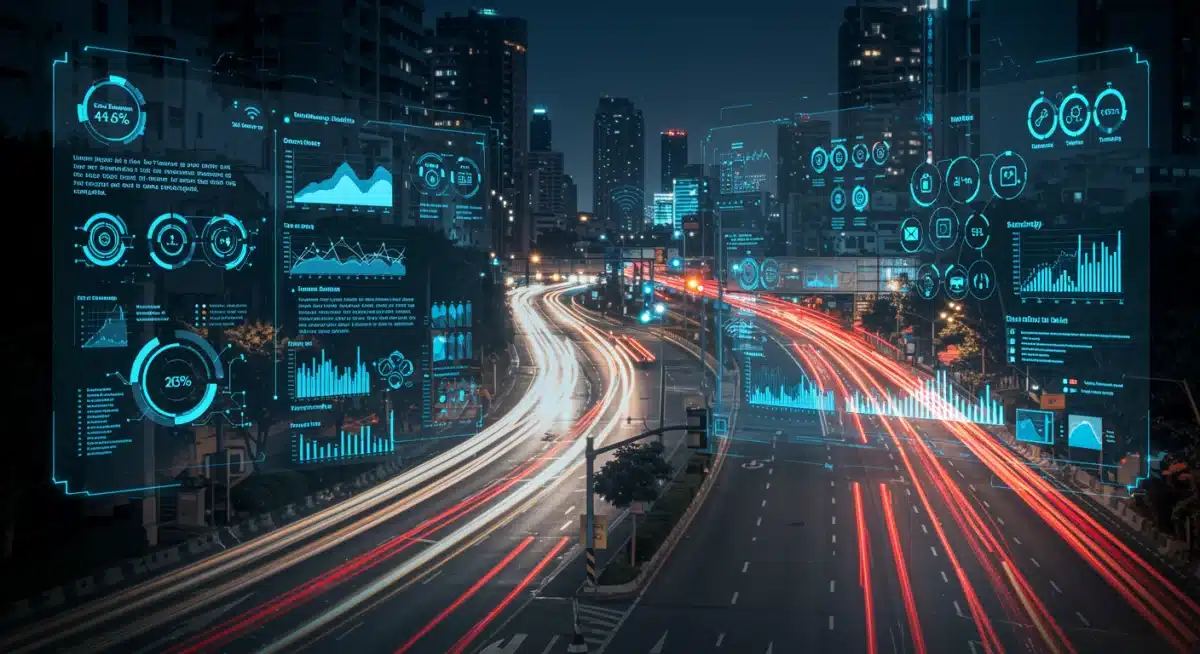
Smart traffic management systems
Imagine a city where traffic lights don’t just follow a static timer but respond dynamically to the actual flow of vehicles and pedestrians. Predictive analytics makes this possible, reducing commute times and minimizing idling, which in turn cuts down on emissions. Furthermore, these systems can anticipate the impact of special events or unexpected incidents, proactively adjusting routes and informing commuters.
Beyond road traffic, predictive analytics is also transforming public transportation. By analyzing ridership data, cities can optimize bus and train schedules, deploy additional vehicles during peak hours, and even predict maintenance needs for their fleets, preventing breakdowns and service disruptions. This holistic approach to mobility ensures that transportation networks are not just efficient but also reliable and responsive to citizen needs.
Optimizing public safety and emergency response
Public safety is a paramount concern for any city, and data-driven urban planning offers powerful tools to enhance it. Predictive analytics allows law enforcement and emergency services to move from a reactive stance to a proactive one, significantly improving response times and potentially saving lives. This strategic application of data fosters safer communities.
By analyzing historical crime data, social indicators, and even environmental factors, predictive policing models can identify areas and times with a higher probability of criminal activity. This enables police departments to deploy resources more effectively, increasing visibility in high-risk zones and deterring crime. It’s about being in the right place at the right time, not just after an incident occurs.
Faster and smarter emergency services
- Emergency Response Optimization: Predicting areas with higher likelihood of accidents or medical emergencies to pre-position resources.
- Fire Safety: Analyzing building characteristics and historical fire data to identify high-risk structures for preventative inspections.
- Disaster Preparedness: Modeling potential impacts of natural disasters to inform evacuation plans and resource staging.
For emergency medical services and fire departments, predictive analytics can optimize ambulance and fire truck placement, reducing response times crucial for critical situations. Furthermore, by analyzing patterns in emergency calls, cities can identify underlying issues, such as health disparities or infrastructure vulnerabilities, allowing for targeted preventative programs. This comprehensive approach to public safety builds more resilient and secure urban environments.
Sustainable infrastructure and resource management
The push towards sustainable cities is another area where data-driven urban planning, coupled with predictive analytics, is making significant strides. Managing vital resources like water, energy, and waste efficiently is critical for environmental protection and long-term urban viability. Predictive models enable cities to anticipate demand, identify inefficiencies, and prevent waste.
Consider water management: by integrating data from sensors in water pipes, weather forecasts, and historical consumption patterns, cities can predict leaks, optimize pressure, and manage supply more effectively. This not only conserves a precious resource but also reduces operational costs. Similarly, smart grids use predictive analytics to forecast energy demand and supply, integrating renewable sources more efficiently and preventing blackouts.
Greener cities through data
Waste management also benefits immensely. Predictive models can forecast waste generation rates in different neighborhoods, allowing for optimized collection routes and schedules, reducing fuel consumption and operational hours. This also supports recycling initiatives by identifying areas with high potential for increased participation. The ultimate goal is to create a circular economy within cities, minimizing waste and maximizing resource utility.
Urban infrastructure maintenance, from roads to bridges, can also be made more sustainable. Predictive analytics can identify components at risk of failure based on usage, age, and environmental factors, allowing for preventative maintenance rather than costly emergency repairs. This extends the lifespan of infrastructure, reduces material consumption, and ensures public safety, all while contributing to a greener urban footprint.
Challenges and the path forward
While the promise of data-driven urban planning is immense, its implementation is not without challenges. Data privacy and security are paramount concerns, requiring robust ethical frameworks and technological safeguards. Ensuring equitable access to the benefits of smart city technologies is also crucial to avoid exacerbating existing social inequalities. Furthermore, the technical expertise required to manage and interpret vast datasets can be a barrier for some municipalities.
Another significant hurdle is the initial investment in infrastructure and technology. Implementing IoT sensors, establishing data platforms, and developing predictive models requires substantial capital. However, the long-term cost savings through increased efficiency and improved service delivery often justify these upfront expenses. It’s a strategic investment in the future resilience and prosperity of a city.
Overcoming implementation hurdles
- Data Governance: Establishing clear policies for data collection, storage, and usage to ensure privacy and security.
- Public Engagement: Involving citizens in the planning process to build trust and ensure solutions meet community needs.
- Capacity Building: Investing in training and education for city staff to develop data literacy and analytical skills.
- Inter-agency Collaboration: Breaking down departmental silos to foster data sharing and integrated decision-making.
Despite these challenges, the trajectory for data-driven urban planning is clear. As technology continues to evolve and best practices emerge, more cities will adopt these approaches. The projected 22% improvement in city services in the coming year is just the beginning; the long-term impact on urban quality of life, sustainability, and economic vitality is poised to be even more profound. The path forward involves continuous innovation, collaborative governance, and a commitment to leveraging data for the public good.
| Key Aspect | Brief Description |
|---|---|
| Core Principle | Utilizes real-time and historical data for informed urban decision-making. |
| Predictive Analytics | Forecasts future urban needs and challenges using algorithms and machine learning. |
| Service Improvement | Aims for a 22% improvement in city services efficiency and responsiveness. |
| Key Benefits | Optimized traffic, enhanced public safety, and sustainable resource management. |
Frequently asked questions about data-driven urban planning
Data-driven urban planning involves using vast amounts of real-time and historical data from various sources to inform decisions about city development, resource allocation, and service provision. It moves beyond traditional methods by grounding strategies in verifiable insights rather than assumptions, leading to more efficient and responsive urban management.
Predictive analytics uses statistical algorithms and machine learning to forecast future outcomes based on current and historical data. This enables cities to anticipate needs, such as traffic congestion or potential crime hotspots, allowing for proactive interventions, optimized resource deployment, and more timely service delivery, aiming for significant efficiency gains.
A wide array of data is utilized, including information from IoT sensors (traffic, air quality), geospatial data (mapping, GPS), public records (census, crime statistics), and citizen feedback (social media, engagement platforms). Integrating these diverse datasets creates a comprehensive understanding of urban dynamics.
Citizens benefit from improved quality of life through more efficient city services. This includes reduced traffic congestion, enhanced public safety, better emergency response times, more reliable public transportation, and more sustainable resource management, all contributing to a more livable and responsive urban environment.
Key challenges include ensuring data privacy and security, addressing ethical concerns, overcoming the initial investment costs for technology and infrastructure, and developing the necessary technical expertise within city administrations. Equitable access to smart city benefits and effective inter-agency collaboration are also crucial for success.
Conclusion
The integration of data-driven urban planning and predictive analytics is not merely an incremental improvement; it represents a fundamental shift in how cities function and serve their residents. With projections indicating a 22% enhancement in city services in the coming year, the potential for more efficient, responsive, and sustainable urban environments is undeniable. While challenges remain, the clear benefits in transportation, public safety, and resource management underscore the imperative for cities to embrace these smart solutions. The future of urban living is increasingly intelligent, shaped by data-informed decisions that promise a better quality of life for all.